Ryan McGowan Takes Aim at Celtic After 7–1 Hearts Win, Questions Their European Credentials

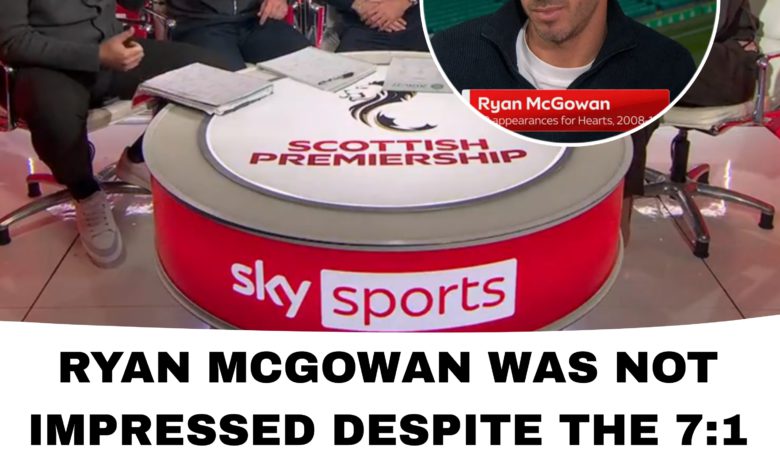
“WE NEVER REALLY STOOD ANY CHANCE BECAUSE OF THE DARK ART FOOTBALL THAT THEY PLAY!” — RYAN MCGOWAN FIRES SHOTS AT CELTIC AFTER 7–1 HEARTS DEMOLITION
Former defender questions Celtic’s European performances, labels them “local champions” and insists domestic dominance does not automatically make them a force in Europe.
Celtic may have delivered a commanding performance against Hearts, but the celebrations surrounding their emphatic 7–1 victory have been overshadowed by a controversial assessment of their football and their ability to compete against Europe’s elite.
Ryan McGowan has raised questions about Celtic’s recent performances, suggesting that their domestic success should not be confused with genuine European superiority. Despite the remarkable scoreline against Hearts, the former defender’s criticism has shifted attention away from the result and towards a familiar debate surrounding the Scottish champions: can Celtic translate their dominance at home into consistent performances on the European stage?
McGowan’s alleged assessment, centred on the phrase, “We never really stood any chance because of the dark art football that they play,” has added another dimension to the discussion surrounding Celtic’s playing style.
His criticism is particularly striking because it comes after a match in which Celtic demonstrated their attacking potential by putting seven goals past Hearts.
For Celtic supporters, a 7–1 victory is precisely the sort of performance that deserves recognition. For critics, however, one emphatic domestic result does not necessarily answer the bigger questions about the club’s European ambitions.
THE 7–1 VICTORY THAT FAILED TO SILENCE THE CRITICS
Celtic’s performance against Hearts provided plenty of reasons for supporters to celebrate. Scoring seven goals in a competitive league fixture is a statement of attacking intent, and such a result can give a team considerable confidence.
However, McGowan’s criticism, as presented in the supplied scenario, focuses on a different issue.
Rather than judging Celtic exclusively by their domestic results, he questions whether their performances against Scottish opposition accurately reflect their standing in European football.
The distinction is important. A team can dominate its domestic league while finding life considerably more difficult against opponents with greater financial resources, deeper squads and different tactical approaches.
Celtic’s challenge is therefore not simply to win matches in Scotland. It is to establish that their football can deliver comparable success when the opposition possesses the quality and tactical discipline required to expose weaknesses.
That is the question McGowan’s criticism brings into focus.
WHY RYAN MCGOWAN’S COMMENTS COULD SPARK A MAJOR DEBATE
The description of Celtic as “local champions” is particularly provocative.
It suggests that domestic success alone is insufficient to establish a club’s status among Europe’s leading sides. For a club with Celtic’s history, following and ambitions, that is a challenge supporters are unlikely to accept without a response.
Celtic have built their reputation through domestic trophies, passionate support and memorable European nights. Their supporters can point to the club’s history in continental competition as evidence that Celtic are more than a team that simply dominates Scotland.
Nevertheless, football has changed significantly.
The financial gap between clubs competing in Europe’s strongest leagues and those operating in smaller domestic markets can make sustained continental success difficult. Recruitment budgets, squad depth and the ability to retain leading players all influence what clubs can realistically achieve.
That context does not automatically excuse disappointing European performances. It does, however, explain why a club can be highly competitive domestically while struggling to reproduce the same level of dominance against elite opposition.
McGowan’s reported criticism challenges Celtic to prove that their domestic achievements can translate into a more convincing European campaign.
WHAT DOES “DARK ART FOOTBALL” REALLY MEAN?
The phrase “dark arts” has become common in football discussions about the tactical and psychological side of the game.
It can refer to time management, tactical fouls, disrupting an opponent’s rhythm, winning free kicks, slowing the tempo or using physicality and gamesmanship to gain an advantage.
Some supporters see these methods as intelligent competitive football. Others believe they undermine the spectacle, particularly when a team appears more interested in disrupting its opponent than allowing the match to flow.
However, the phrase can mean different things depending on the match and the speaker.
Without a verified, complete account of McGowan’s comments, it would be unfair to claim that he identified a particular Celtic tactic or accused the club of deliberately breaking the rules.
The broader debate remains relevant: should teams be judged solely by their results, or should the methods they use to achieve those results also be scrutinised?
For Celtic, the strongest response would be to demonstrate that their success rests on more than domestic familiarity or the ability to make matches uncomfortable for opponents.
Their attacking football, tactical organisation and performances against stronger opposition are all part of that assessment.
CELTIC’S EUROPEAN PERFORMANCES UNDER THE SPOTLIGHT
The most significant element of the criticism is the question surrounding Celtic’s European credentials.
European competition presents a different challenge from the Scottish Premiership. Celtic must adapt to opponents with different tactical systems, greater individual quality in certain positions and the ability to punish mistakes quickly.
In domestic football, Celtic often have the resources and attacking quality to control matches. In Europe, that control can become harder to establish.
Possession does not always translate into clear chances, pressing can leave spaces behind the defence, and a single defensive error can change the direction of a contest.
The difference between domestic dominance and European competitiveness is therefore not simply a matter of confidence. It also involves tactical flexibility, recruitment, defensive organisation and the ability to perform under sustained pressure.
If Celtic want to silence critics who question their continental ambitions, their performances in European competition will carry more weight than any single domestic scoreline.
A 7–1 victory can demonstrate attacking quality. Consistent performances against strong European opponents would provide a more convincing answer to questions about the club’s wider standing.
MARTIN O’NEILL AND THE CHALLENGE OF PROVING THE DOUBTERS WRONG
For Martin O’Neill, the central challenge is to ensure that Celtic’s domestic success forms part of a wider plan rather than becoming the only measure of progress.
A convincing victory against Hearts can boost confidence and create momentum. It can also give the coaching staff an opportunity to assess the team’s attacking combinations, movement and ability to exploit defensive weaknesses.
But the demands of European football require more than scoring freely against domestic opposition.
Celtic must be capable of adjusting when opponents press aggressively, defending effectively when they surrender possession and remaining composed when a match becomes tactically complicated.
The manager’s ability to prepare the squad for those different situations will be crucial to the team’s ambitions.
If Celtic respond to criticism by producing stronger European performances, the debate could eventually work in their favour. If the same concerns persist, critics will continue to question whether domestic success is masking shortcomings at a higher level.
CELTIC SUPPORTERS ARE UNLIKELY TO ACCEPT THE “LOCAL CHAMPIONS” LABEL
Celtic supporters have every reason to take pride in a dominant domestic performance. Winning 7–1 is not an achievement that should be dismissed simply because the match takes place in Scotland.
The scoreline demonstrates what a team can accomplish when its attacking players perform effectively and its opponents struggle to contain them.
However, supporters also understand that European football represents a different test.
The disagreement is not necessarily about whether Celtic are a successful domestic club. Their history and achievements provide ample evidence of that success.
The real question is how their domestic standing compares with their ability to compete against Europe’s strongest teams.
Calling Celtic “local champions” reduces a complicated footballing debate to a provocative label. It may generate arguments, but the more meaningful assessment must consider the club’s results, performances, resources and progress over time.
Ultimately, neither a single heavy victory nor a single criticism provides a complete picture of Celtic’s capabilities.
THE FINAL VERDICT: A BIG DOMESTIC WIN DOES NOT END THE EUROPEAN DEBATE
Celtic’s 7–1 victory over Hearts, as described in the supplied scenario, offers an emphatic reminder of their attacking potential.
Yet the controversy surrounding McGowan’s reported remarks highlights a broader issue that follows many successful domestic clubs: the challenge of converting national dominance into consistent European achievement.
Celtic can celebrate their domestic performances while acknowledging that European football requires a different level of preparation, tactical adaptability and consistency.
The ultimate response to criticism will not come through arguments on television or social media. It will come through performances on the pitch.
If Celtic can combine their domestic attacking strength with convincing displays against Europe’s leading sides, the “local champions” label will become increasingly difficult to defend.
Until then, the debate will continue.
One question remains: are Celtic being judged unfairly because of the limitations of Scottish football, or must they deliver more in Europe before they can claim a place among the continent’s leading clubs?