Manchester City Owners’ Reported Celtic Takeover Talks Spark Fears Across Scottish Football

“They’ve Damaged England Football — Now They’re Coming to Scotland”: Manchester City Owners’ Celtic Talks Spark Scottish Premiership Fears
“They’ve damaged England football, and now they’re coming to Scotland.”
That is the growing fear among sections of Scottish football following reports that representatives linked to the owners of Manchester City have held talks with major shareholders connected to Celtic over a possible takeover.
The rumours have sent shockwaves through the Scottish football landscape, with supporters and rival clubs beginning to ask the same uncomfortable question:
What would happen to Scottish football if the people behind Manchester City were to take control of Celtic?
For some, the possibility represents nothing more than another major investment opportunity in European football.
For others, it could completely transform the balance of power in Scotland.
And there are already voices warning that the Scottish Premiership could become a competition in which the outcome is increasingly predictable.
“It’s over for the Scottish Premiership”
The phrase has already begun circulating among supporters concerned about what a financially powerful ownership group could mean for Celtic.
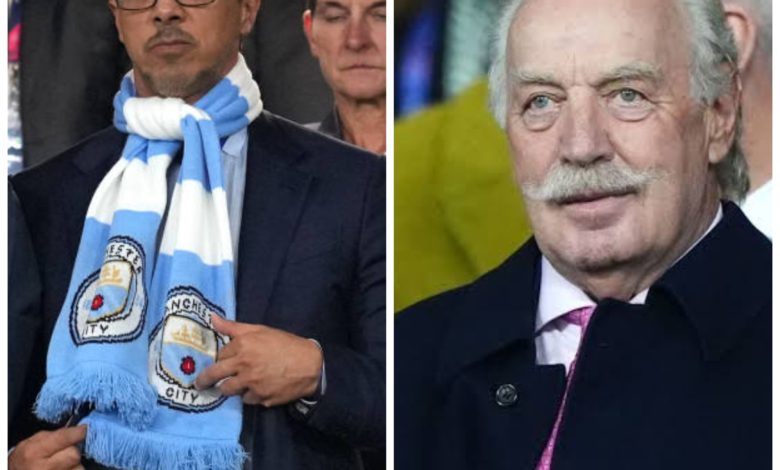
Manchester City have, over the years, developed into one of the most powerful clubs in European football following their takeover by Sheikh Mansour’s Abu Dhabi-linked ownership group in 2008.
The investment that followed transformed City from a club competing for occasional domestic honours into a team capable of challenging for the biggest trophies in world football.
That transformation has also made City one of the most controversial clubs in English football.
The Premier League’s long-running financial case against Manchester City has created an enormous amount of debate around financial regulations, sponsorship arrangements, competitive balance and the ability of wealthy ownership groups to reshape football.
Manchester City deny wrongdoing and have contested the allegations.
But for critics of the modern football ownership model, the saga has become symbolic of a much bigger problem.
They fear that financial power can eventually become sporting power.
And now, with Celtic reportedly being discussed as a possible new investment target, similar concerns are beginning to emerge north of the border.
The Celtic situation
The possibility of a takeover would represent one of the biggest stories in Scottish football in decades if it were ever to progress beyond discussions.
Celtic are already one of Scotland’s biggest and most commercially powerful clubs.
They possess an enormous domestic support base, a historic European identity and one of the largest stadiums in the country.
A new ownership group with access to the financial resources associated with City Football Group could potentially give Celtic opportunities that other Scottish Premiership clubs simply cannot match.
It could mean greater recruitment budgets.
It could mean improved infrastructure.
It could mean increased investment in youth development.
It could mean a much greater presence in international markets.
But it could also create an entirely different competitive environment.
And that is precisely what is worrying rival supporters.
Behind the scenes, the takeover talk
At the centre of the speculation are reports that representatives connected to Manchester City’s ownership structure have held discussions with Celtic’s major shareholders regarding a possible takeover.
If such discussions are confirmed and eventually lead to a formal offer, the consequences would extend far beyond Celtic Park.
The Scottish Premiership’s financial structure is already heavily dependent on the commercial strength of Celtic and Rangers.
A major external investment into one of those clubs could create an even greater financial divide between the leading clubs and the rest of the league.
That is why rival clubs are understandably watching developments closely.
The concern is not necessarily that investment itself is bad.
Quite the opposite.
Investment can improve stadiums, academies, recruitment, coaching, sports science and the overall quality of a club.
The question is what happens when one club suddenly possesses financial resources dramatically beyond those of its domestic competitors.
Other Scottish clubs are watching
There is growing concern among sections of Scottish football that a Celtic takeover by a City-linked ownership group could fundamentally alter the competitive landscape.
Imagine Celtic being able to operate with the financial muscle of a global football organisation.
Imagine being able to attract players who would otherwise have no reason to consider Scotland.
Imagine Celtic having access to scouting networks, commercial partnerships and football infrastructure stretching across several countries.
For clubs already struggling to compete financially with Celtic and Rangers, such a development could feel overwhelming.
One rival executive could look at the situation and ask:
“How are we supposed to compete with that?”
That is the heart of the issue.
The Scottish Premiership is not the Premier League.
Its television revenue is significantly smaller.
Its clubs generally operate with considerably smaller budgets.
And European qualification can make an enormous difference to a club’s finances.
If Celtic were to receive another substantial injection of capital, the competitive gap could potentially become even wider.
The “rigged game” argument
This is where the most controversial accusations begin.
Some supporters fear that Scottish football could become a competition where financial inequality becomes so significant that sporting competition loses its meaning.
The phrase “the game is about to be rigged” may sound extreme, but it reflects a genuine concern among people who believe modern football has allowed financial power to become too influential.
Of course, ownership alone does not automatically mean a competition has been rigged.
A wealthy owner still has to appoint the right manager, recruit the right players and build the right football structure.
Money cannot guarantee every trophy.
But money can dramatically change what is possible.
And that is why the potential Celtic development is attracting so much attention.
The Manchester City comparison
Manchester City’s rise provides the obvious comparison.
Before the Abu Dhabi takeover, City had experienced long periods outside English football’s elite.
Following the takeover, enormous investment transformed the club’s infrastructure and playing squad.
The club subsequently became a dominant force in English football and established itself among Europe’s elite.
Critics argue that this illustrates the enormous competitive advantage that can be created when football clubs are backed by extraordinary financial resources.
Supporters of City’s ownership model, however, point to the club’s investment in infrastructure, academy development, recruitment and global expansion.
Both sides of that argument are likely to become relevant if Celtic’s reported discussions develop further.
And then there is the financial controversy
For Scottish supporters, however, the most uncomfortable part of the story is not simply the money.
It is the shadow cast by the long-running Manchester City financial controversy.
The Premier League has accused Manchester City of numerous alleged breaches of its financial rules over a prolonged period. Manchester City have strongly denied the allegations and the matter has been subject to an independent legal process.
That distinction is important.
Allegations are not the same thing as proven wrongdoing.
Nevertheless, the saga has become one of the defining financial stories in modern English football.
And it is inevitable that Scottish supporters would ask whether a similar ownership model could eventually bring similar controversies north of the border.
“Not even the SFA can stop it”
Another question being raised is the role of Scottish football’s governing authorities.
If a major international investment group wanted to acquire Celtic, any transaction would still have to operate within the applicable football regulations, company law, competition rules and ownership requirements.
The Scottish Football Association would therefore have a regulatory role within its remit.
But supporters asking whether the SFA could “stop it” are really asking a much bigger question:
How much control should football authorities have over who owns its biggest clubs?
That debate is unlikely to disappear.
Football authorities across Europe have increasingly had to deal with wealthy owners, multi-club ownership structures and financial regulations designed to protect competitive integrity.
Scotland would not be immune from those issues.
Celtic supporters face a huge decision
For Celtic supporters, a potential takeover would not simply be about money.
It would be about identity.
Celtic is a club with more than a century of history, a distinctive supporter culture and an identity that extends far beyond what happens on the pitch.
Any potential new ownership group would therefore face questions about its intentions.
Would Celtic remain culturally independent?
Would the club become part of a much larger global football network?
Would Celtic become another component of an international multi-club structure?
Would investment go into the academy and stadium?
Would supporters have meaningful influence?
And perhaps most importantly:
Would the new owners respect what Celtic means to its supporters?
These questions would become central to any serious takeover discussion.
The rest of Scotland cannot simply ignore it
For Rangers, Aberdeen, Hearts, Hibernian and the other Premiership clubs, this is not merely a Celtic issue.
If Celtic received a major financial injection, every ambitious club in Scotland would have to consider how it could respond.
Rangers would undoubtedly remain Celtic’s principal domestic challenger, but even Rangers would have to consider the consequences of a dramatically strengthened Celtic.
For clubs further down the table, the challenge could be even greater.
The fear is that Scottish football could increasingly become divided into two categories:
those who can compete with Celtic financially — and those who cannot.
That could have consequences for attendance, European qualification, player recruitment and even the attractiveness of the league itself.
But is the Scottish Premiership really “finished”?
Not necessarily.
Football has a strange habit of producing unexpected results.
Money does not automatically produce good football.
A huge transfer budget can be wasted.
A famous manager can fail.
A talented squad can collapse under pressure.
And smaller clubs can still produce extraordinary seasons.
Scottish football has repeatedly demonstrated that unpredictability remains possible.
However, the concern about financial imbalance should not simply be dismissed.
If a club already operating from a position of enormous domestic strength suddenly receives substantially greater financial backing, the competitive consequences deserve serious discussion.
A potential turning point
That is why the reported talks have generated so much attention.
If nothing comes from them, the story could eventually disappear.
If discussions progress to a formal proposal, however, Scottish football could find itself facing one of the most important ownership debates in its modern history.
Celtic would have to decide whether the financial opportunity was worth the potential transformation of the club.
Supporters would have to decide whether they welcomed the investment.
Rival clubs would have to consider how they could remain competitive.
And Scottish football authorities would have to ensure that any transaction complied with the relevant regulations.
One thing is certain: the reaction would be enormous.
Because this would not simply be another football takeover.
It would potentially bring one of the world’s most powerful football ownership models into Scottish football.
And that is why some supporters are already warning:
“They’ve damaged England football — now they’re coming to Scotland.”
“It’s over for the Scottish Premiership.”
“The game is about to be rigged.”
And perhaps the biggest question of all:
If Celtic really does become part of the Manchester City ownership world, who in Scottish football will be capable of stopping the transformation?