“Yes, that is what you English say!” — Henrik Larsson Fires Back at the “It’s Only the Scottish League” Argument as Celtic Legend Reminds England of Their Defeats
Henrik Larsson has delivered a passionate response to one of the most persistent criticisms directed at Scottish football, insisting that the achievements of Celtic and other Scottish clubs should not simply be dismissed because they were made north of the border.
The former Celtic superstar was speaking about the perception that playing in Scotland somehow diminishes a player’s achievements, despite the fact that the Swede spent his career sharing dressing rooms with some of the greatest footballers of his generation and competing on some of the biggest stages in European football.
The conversation quickly touched on an argument Celtic supporters have heard countless times.
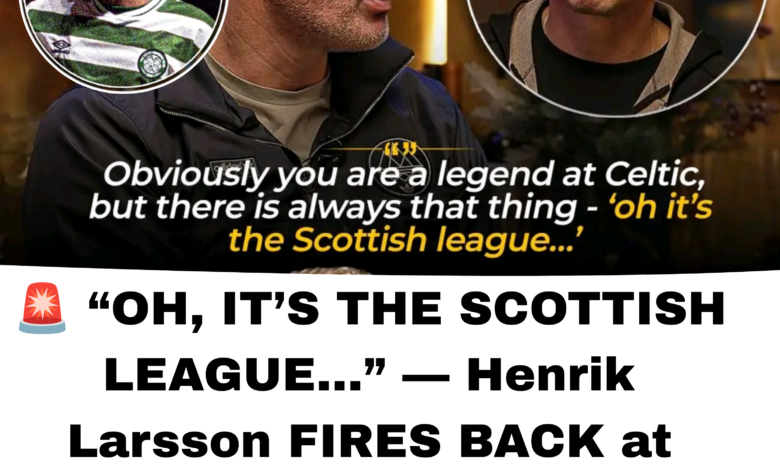
“Obviously you are a legend at Celtic, but there is always that thing – ‘oh, it’s the Scottish league…’”
Larsson’s response was simple, direct and packed with confidence.
“Yes, that is what you English say. We played against a few English teams and we beat them – and you were one of them!”
It was the kind of response that immediately brings back memories of Celtic’s historic European nights and Larsson’s own remarkable record during his time in Glasgow.
Larsson’s Celtic legacy remains difficult to ignore
For many Celtic supporters, Larsson’s name requires no introduction.
The Swedish striker arrived at Celtic and developed into one of the most feared forwards in Europe, combining movement, finishing, intelligence and an extraordinary ability to produce when the pressure was at its highest.
His time in Glasgow turned him into a Celtic icon, but his career eventually took him far beyond Scotland.
He would go on to represent Barcelona and Manchester United, while also becoming an important figure for Sweden.
Across his international career, Larsson scored 37 goals in 106 appearances, while his club career saw him play alongside some of the most gifted footballers of his generation.
That is precisely why the argument that his Celtic achievements should be viewed through the narrow lens of the Scottish Premiership has always been difficult to accept.
Larsson did not merely play football in Scotland.
He competed in European competition, faced elite opposition and eventually earned opportunities at two of the biggest clubs in world football.
And when discussing the players he shared a dressing room with, his choices provide another reminder of just how extraordinary his career was.
Messi and Cristiano Ronaldo surprisingly miss out
Larsson played alongside Lionel Messi at Barcelona and Cristiano Ronaldo during his short spell at Manchester United.
Yet, surprisingly, neither player made his personal list of the three greatest teammates he ever had.
That revelation alone was enough to attract attention.
When discussing Messi, Larsson admitted that even he could not have predicted just how extraordinary the Argentine would eventually become.
The Swede explained that Messi already possessed remarkable technical ability, a fantastic left foot and exceptional speed, but at the time it was difficult for him to imagine the youngster eventually surpassing Ronaldinho.
History, of course, proved otherwise.
Messi went on to become one of the greatest players in football history, while Ronaldo developed from an exciting winger into one of the most devastating goalscorers the sport has ever produced.
But Larsson’s selections were not necessarily based purely on individual statistics.
Instead, he looked at the qualities of players he had actually shared a pitch and dressing room with.
And his three choices make for fascinating reading.
—
🇧🇷 Ronaldinho — The Brazilian magician
One of Larsson’s most obvious selections was Ronaldinho.
The Brazilian superstar represented everything beautiful about football.
Flair, imagination, technique, unpredictability and an almost effortless ability to entertain.
Larsson was part of Barcelona’s Champions League-winning side in 2006, with Ronaldinho playing a central role in that historic team.
The Swede shared the pitch with Ronaldinho on numerous occasions, and it is easy to understand why the Brazilian left such an impression.
Ronaldinho was capable of producing moments that appeared impossible.
A defender could know exactly what he was attempting and still struggle to stop him.
His close control, dribbling ability, passing range and creativity made him one of the most entertaining players of his generation.
Yet Larsson offered an interesting twist when discussing whether Ronaldinho was the best player he had ever played alongside.
The former Celtic striker pointed towards another name from his time in Scotland.
🇸🇰 Ľubomír Moravčík earns enormous praise
For Celtic supporters, perhaps the most interesting part of Larsson’s comments was his praise for Ľubomír Moravčík.
Larsson spoke about the Slovakian midfielder with tremendous admiration, particularly highlighting his technique and ability to find teammates from seemingly impossible positions.
He even joked that he could never quite tell whether Moravčík was left-footed or right-footed.
That uncertainty was itself a compliment.
Moravčík possessed the technical ability to use either foot naturally, making him extremely difficult to read.
For Larsson, the Slovakian’s vision and creativity were extraordinary.
And it is another reminder that footballers can sometimes appreciate qualities that statistics simply cannot capture.
A player might not have the worldwide profile of Messi or Ronaldo, but to someone sharing the pitch with him every day, his influence can be just as impressive.
—
🏴 Wayne Rooney — The Englishman Larsson admired
Then comes Wayne Rooney.
When Larsson arrived at Manchester United on loan in 2007, Rooney was still relatively young but was already establishing himself as one of the most important players at Old Trafford.
Larsson only played alongside Rooney on a limited number of occasions, but the Swede had already seen enough.
Rooney possessed an aggressive mentality, extraordinary determination and an almost relentless desire to influence matches.
From his teenage breakthrough at Everton to becoming one of Manchester United’s greatest-ever players, Rooney’s career was built around intensity.
He was not simply a goalscorer.
He could create chances, press defenders, drop into midfield, play wide and produce spectacular finishes.
Larsson experienced that talent first-hand during his brief spell in Manchester.
Rooney would eventually become Manchester United’s all-time leading goalscorer, scoring 253 goals in 559 appearances for the club.
He also won five Premier League titles and became one of the defining English players of his generation.
For Larsson, therefore, Rooney was an obvious example of the exceptional talent he encountered outside Scotland.
—
🟢 Chris Sutton — The Celtic connection
And then there is a name Celtic supporters will immediately appreciate.
Chris Sutton.
Before becoming one of the most recognisable voices in football punditry, Sutton was a formidable striker who had already made his mark in English football with Norwich City and Blackburn Rovers.
But at Celtic, his partnership with Larsson became one of the most memorable attacking combinations of the era.
The pair complemented one another brilliantly.
Larsson possessed the movement and finishing ability to exploit spaces, while Sutton brought physicality, intelligent link-up play and a willingness to battle defenders.
Together, they produced goals and memorable performances for Celtic.
Sutton was more than just a traditional target man.
He could drop deeper, connect midfield with attack and attack crosses with tremendous power.
That all-round ability made him an ideal partner for Larsson.
During their time together at Celtic, Sutton contributed significantly to a partnership that became a major part of the club’s domestic dominance.
And interestingly, Sutton himself has previously spoken extremely highly of Larsson, describing him as the best striker to have played in the Scottish Premiership.
The admiration clearly goes both ways.
—
The “Scottish league” argument refuses to disappear
Larsson’s comments have once again reopened a familiar debate.
There has long been a tendency among some English football supporters to dismiss Scottish football by pointing towards the financial disparity between the two leagues.
The Premier League possesses enormous television revenues, some of the world’s most expensive squads and clubs capable of spending extraordinary amounts of money in the transfer market.
But Larsson’s response highlights another side of the argument.
Football is not played on spreadsheets.
European competition has repeatedly provided opportunities for Scottish clubs to test themselves against English opposition.
And Celtic, in particular, have produced memorable European nights throughout their history.
Larsson himself was at the centre of many of those occasions.
His point was therefore not simply about defending the Scottish Premiership.
It was about challenging the idea that playing in Scotland automatically means a footballer is playing at an inferior level and therefore deserves less recognition.
Larsson’s career tells its own story
Perhaps the strongest argument for Larsson does not even come from his words.
It comes from what happened after Celtic.
The Swedish striker eventually joined Barcelona and became part of the side that lifted the Champions League trophy.
He later joined Manchester United and made a significant contribution during his short stay at Old Trafford.
That journey is important.
A player who spent years dominating Scottish football was subsequently trusted by some of the biggest clubs in Europe.
And when he arrived at Barcelona, he was not treated as someone who had merely enjoyed success in an isolated league.
He was considered capable of contributing at the highest level.
His performance in the 2006 Champions League final remains particularly memorable, with Larsson coming off the bench and helping Barcelona turn the match around against Arsenal.
It was another moment that demonstrated that the Celtic legend could perform when the stakes were enormous.
—
🗣️ “And you were one of them!”
That is ultimately what makes Larsson’s response so entertaining.
There is an element of history behind it.
English football may have greater financial power, but Scottish football has never lacked pride, passion or the ability to produce players and teams capable of causing problems for supposedly superior opponents.
And Larsson knows that better than most.
He played against English opposition.
He played alongside English legends.
He played for Barcelona.
He played for Manchester United.
He played international football for Sweden.
And through all of that, he never forgot what Celtic meant to his career.
For Celtic supporters, that will probably be the biggest takeaway.
Larsson’s legacy in Glasgow does not need validation from England.
His achievements speak for themselves.
He arrived as a talented striker and left as a Celtic icon.
He then went on to prove himself in Spain, England and on the European stage.
So when someone says, “Oh, but it’s the Scottish league…”, Larsson’s answer is perhaps the perfect response:
“Yes, that is what you English say. We played against a few English teams and we beat them — and you were one of them!”
For Celtic fans, that is not merely a comeback.
It is a reminder of an era when Henrik Larsson made Scottish football impossible to ignore.