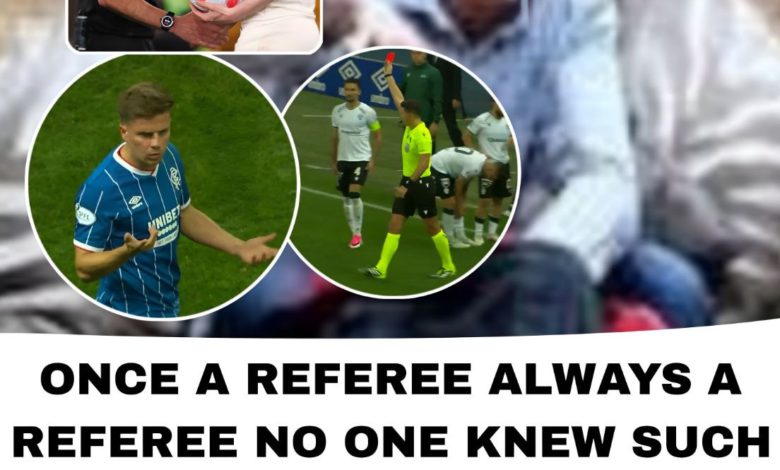
Ex-Premier League Referee Martin Atkinson Has His Say on Devlin Red Card Against FK Jablonec — And It’s Not What Everyone Was Thinking
Former Premier League referee Martin Atkinson has reportedly offered a different interpretation of Cammy Devlin’s controversial red card during Rangers’ 1–0 UEFA Conference League play-off victory over FK Jablonec at Ibrox.
Devlin’s dismissal became one of the biggest talking points of the night after the Rangers midfielder was shown a straight red following a VAR review in the second half. The decision came shortly after he had been introduced from the bench, leaving Rangers to defend their narrow advantage with ten men.
The incident occurred in the 74th minute, with referee Marian Barbu consulting the pitchside monitor before producing the red card.
But while the decision has generated plenty of debate, Atkinson’s alleged assessment provides another angle on what happened.
“HE WENT FOR THE BALL”
According to the view attributed to Atkinson, the key factor is not simply where Devlin’s boot eventually made contact, but how the challenge developed.
The former referee believes Devlin initially went for the ball and that the position of his body changed during the challenge.
«“From what I view, the defender went for the ball then his left leg slipped, which caused the collision.”»
That interpretation could significantly change how supporters look at the incident.
Rather than viewing Devlin’s movement as a deliberate attempt to make dangerous contact with the Jablonec player, the argument is that the collision may have resulted from an unfortunate loss of footing during an attempt to win possession.
The distinction is important because refereeing decisions involving serious foul play often depend heavily on the player’s action, the manner of the challenge and the point of contact.
THE FOOT POSITION WAS THE BIG QUESTION
Atkinson’s explanation reportedly focuses heavily on the position of Devlin’s feet.
The former Premier League official believes the referee has to carefully assess the movement of both legs before determining whether the contact was deliberate or reckless enough to warrant a sending-off.
«“The rule is that the referee must watch the position of the feet, see where the other leg is, then decide whether it’s intentional or not.”»
That is where the controversy begins.
From one angle, Devlin’s challenge appeared dangerous because of the eventual contact with the Jablonec player.
However, another interpretation is that the midfielder’s movement was altered when his supporting leg slipped, causing the challenge to look significantly worse than the initial action intended.
For Rangers supporters, that distinction could be crucial.
RED CARD OR UNFORTUNATE COLLISION?
The incident was reviewed by VAR before the referee made the final decision.
Reports from the match confirm that Devlin was sent off after the VAR intervention, with Rangers subsequently forced to protect their 1–0 advantage with ten men.
The decision was particularly frustrating because Devlin had only recently entered the game.
Instead of helping Rangers control the closing stages, the midfielder was sent down the tunnel and immediately became the centre of attention.
The Rangers players then had to withstand late pressure from Jablonec, knowing that conceding an equaliser would have dramatically changed the complexion of the tie.
Thankfully for Rangers, Ryan Naderi’s second-half goal ultimately proved enough to secure the win.
“HIS LEG SLIPPED”
The strongest part of the alternative interpretation is the claim that Devlin’s left leg slipped.
If that happened during the challenge, it could explain why his body position changed and why his boot eventually made such heavy contact.
«“From what I saw, his leg slipped, so it shouldn’t have been a red card.”»
That is a completely different assessment from simply saying the challenge was reckless.
It suggests the incident should be examined from the beginning of the movement rather than only from the moment of impact.
And that is exactly why VAR decisions involving challenges can remain controversial even after multiple replays.
THE INTENT DOESN’T TELL THE WHOLE STORY
However, there is another side to the argument.
A player does not necessarily have to deliberately intend to injure an opponent for a challenge to constitute serious foul play.
That is why the incident has attracted so much debate.
The referee must assess the nature of the challenge, the force used, the point of contact and the potential danger to the opponent.
In Devlin’s case, the referee ultimately determined that the challenge warranted a red card after reviewing the footage.
Other pundits have also debated the decision. One report noted that former Rangers player Andy Halliday initially found the incident baffling but later accepted the sending-off after seeing the replay, while Steven Thompson questioned whether greater transparency around VAR explanations would help supporters understand such decisions.
So Atkinson’s interpretation represents one side of a genuinely controversial refereeing debate, rather than an established overturning of the decision.
A NIGHTMARE START FOR DEVLIN
The timing made the incident even more painful for Devlin.
The midfielder had been brought on to help Rangers manage the match, but within minutes he was no longer on the pitch.
Instead, he became the player everyone was talking about.
For a player trying to establish himself under Derek McInnes, it was hardly the introduction he would have wanted.
McInnes has already spoken about the type of midfielders he wants in his team — players with energy, aggression and the willingness to compete for every ball.
Devlin certainly demonstrated his willingness to challenge for possession.
Unfortunately, the challenge ended with him receiving the most severe punishment available to the referee.
RANGERS STILL GOT THE JOB DONE
Despite the controversy, Rangers deserve credit for surviving the final stages.
Naderi’s 50th-minute goal gave the home side the advantage, but Devlin’s dismissal changed the match completely.
Rangers had to become more defensive and protect their lead rather than continue searching aggressively for another goal.
The final statistics show that Rangers still had more possession and more shots, but Jablonec’s late pressure meant the home side could not afford to relax.
The 1–0 result gives Rangers an advantage going into the second leg, although the narrow margin means the tie remains very much alive.
And Devlin will now be unavailable for that return fixture following his dismissal.
ATKINSON’S VIEW WILL ONLY ADD TO THE DEBATE
Whether Rangers supporters agree with Atkinson’s interpretation or not, his explanation raises an important question about the incident.
Was Devlin deliberately making a dangerous challenge, or did a slip during an attempt to win the ball cause the collision?
That is the question that will continue to dominate discussion.
The referee and VAR officials ultimately judged the challenge to be worthy of a straight red.
Atkinson’s alternative view, however, suggests that the movement of Devlin’s legs and the circumstances leading to the contact deserved greater consideration.
For Rangers fans who felt the decision was harsh, it provides ammunition for their argument.
For those who believe the red card was justified, the fact that Devlin’s studs made high contact with Jablonec’s player remains a major factor.
One thing is certain: the Devlin red card has not ended with the final whistle at Ibrox.
It has instead opened another debate about VAR, intent, player movement and how referees should judge challenges where the final point of contact may not tell the entire story.
Rangers left Ibrox with a 1–0 victory, but they also left with a major talking point.
And if Atkinson’s assessment is accurate, then his conclusion will certainly surprise those who believed the red card was an obvious decision.
For the former Premier League referee, Devlin’s leg slipping may have been the crucial detail — and that could mean the Rangers midfielder was punished for the outcome of the challenge rather than the intention behind it.