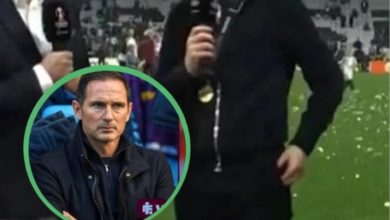
“I Don’t Understand Why They Were Applauding Him” — Chris Sutton Questions Celtic star Performance Despite 3–0 Win
Celtic may have secured a comfortable 3–0 victory, but former Hoops striker Chris Sutton was far from convinced by the performance of one Celtic star.
While the majority of supporters left the stadium delighted with the result and applauded the players for another impressive display, Sutton’s attention was drawn to Hassan Hosseim, whose performance he believed exposed a worrying weakness in Celtic’s game.
For Sutton, the final scoreline was not enough to completely hide what he saw from Hosseim.
The Celtic supporters were understandably in a positive mood. Three goals, three points and another convincing result gave the home crowd plenty to celebrate. Hosseim also had moments during the match where he showed his attacking ability and attempted to influence the game.
However, Sutton’s assessment was much more critical.
The former Celtic striker questioned why Hosseim was receiving applause when, in his view, the midfielder’s contribution without the ball was not good enough.
“I don’t understand why they were applauding him,” was the sentiment behind Sutton’s criticism. “To me, he reduced Celtic down to 10 men.”
It was a brutal assessment of Hassan Hosseim, especially considering Celtic had just completed a comfortable 3–0 victory.
Sutton’s frustration was not necessarily about Hosseim’s ability on the ball. Instead, it centred around what happened whenever Celtic lost possession.
The Celtic star appeared to struggle with his defensive responsibilities, and that became a major talking point.
Hosseim was expected to contribute more when Celtic did not have the ball, particularly when Aberdeen attempted to launch attacks. But Sutton felt that the player did not provide enough defensive effort to support his teammates.
And that is where the criticism became particularly harsh.
Despite the positive result, Sutton believed Hosseim’s lack of defensive contribution meant Celtic were effectively playing with one fewer player whenever possession changed hands.
The criticism was especially focused on Hosseim’s tendency to lose possession without immediately making the effort to recover his position.
He showed flashes of attacking quality, but Sutton wanted to see much more intensity after the ball was lost.
Hosseim lost the ball too easily but couldn’t track back, according to the assessment.
That became the biggest concern.
In modern football, attacking players are not simply expected to create chances and score goals. They are also required to press, track runners and help their team recover its shape.
For Sutton, Hosseim’s performance did not meet that standard.
The issue becomes even more significant when considering Celtic’s ambitions.
A 3–0 victory can make defensive weaknesses easier to overlook. When a team is comfortably ahead, mistakes and lapses in concentration do not always result in punishment.
But against stronger opposition, the same mistakes could prove extremely costly.
That is precisely why Sutton’s criticism of Hosseim should not simply be dismissed because Celtic won.
The former Celtic striker appeared to be looking beyond the scoreline and examining whether Hosseim’s overall contribution was good enough for a player wearing the Celtic shirt.
There were moments when Hosseim looked dangerous and attempted to make things happen in the attacking areas.
But for Sutton, those moments were not enough to compensate for his work off the ball.
The criticism became particularly uncomfortable when the question of work rate was raised.
Sutton’s assessment was that Celtic cannot afford to carry a player who does not consistently track back after losing possession.
“Celtic doesn’t need such a lazy player,” was the blunt conclusion of the criticism.
Those words will certainly divide Celtic supporters.
Some fans will argue that Hosseim deserves credit for the positive things he brought to the game and that a player should not be judged solely by defensive statistics.
Others will agree with Sutton and argue that every Celtic player must be willing to work for the team, particularly when possession is lost.
And there is another side to the debate.
Hosseim’s supporters can point to the fact that Celtic scored three goals and kept a clean sheet. Whatever shortcomings existed in his performance, the team still delivered exactly what the supporters wanted — a convincing victory.
But Sutton’s point is that Celtic cannot allow the scoreline to disguise individual weaknesses.
A player can be part of a winning team and still have areas of his performance that need serious improvement.
For Hosseim, the biggest challenge will be proving that Sutton’s assessment was too harsh.
If he can improve his defensive discipline, react quicker after losing possession and show greater determination when tracking back, the criticism could quickly disappear.
His attacking qualities are not necessarily the issue.
The question is whether he can combine those qualities with the intensity required when Celtic are defending.
That could ultimately determine how supporters and pundits judge his performances moving forward.
For now, Celtic have the result they wanted.
Three goals.
Three points.
And plenty of reasons for supporters to celebrate.
But Chris Sutton has created another debate by putting the spotlight directly on Hassan Hosseim.
While the Celtic faithful applauded their team after a 3–0 victory, Sutton saw a player whose performance left him asking whether Celtic can afford to carry someone who does not contribute enough without the ball.
The result may have been comfortable.
The performance may have been enough to secure victory.
But according to Sutton’s assessment, Hassan Hosseim still has something to prove.