Chris Sutton Delivers Brutal Verdict on Controversial VAR Decision in Aberdeen vs Rangers Clash

Brutal Verdict From Chris Sutton — He Got Boyd Shut Up
Chris Sutton has delivered a brutal verdict on the controversial VAR decision that denied Aberdeen a late equaliser against Rangers, with his three-word message to the officials sending social media into meltdown.
The Aberdeen-Rangers clash at Pittodrie has continued to dominate discussion long after the final whistle, with the result being overshadowed by a series of contentious refereeing and VAR decisions that left Aberdeen supporters furious.
Rangers eventually walked away with a narrow victory, but the biggest talking point came late in the match when Aberdeen thought they had found a dramatic equaliser.
The goal initially sparked wild celebrations among the home supporters. However, those celebrations were short-lived after VAR intervened and referee Matthew MacDermid was advised to review the incident.
Following the review, the goal was ruled out for a foul in the build-up, leaving Aberdeen players visibly frustrated and supporters questioning why the intervention had been made.
And now, former Celtic striker and outspoken football pundit Chris Sutton has entered the debate with a verdict that has sent social media into overdrive.
Sutton refuses to stay quiet
Sutton has never been known for hiding his opinion when it comes to controversial refereeing decisions, and this latest incident appears to have pushed him over the edge.
The pundit reportedly took aim at the decision to disallow Aberdeen’s late equaliser, describing it as a “daylight robbery” and making it clear that he believed the VAR intervention had gone too far.
His reaction immediately attracted attention because the decision has already divided Scottish football.
While Rangers supporters have defended the officials and argued that Aberdeen’s player committed a foul before the ball went into the net, Aberdeen supporters have insisted that the contact was nowhere near enough to justify cancelling such an important goal.
Sutton’s intervention has therefore added another layer to an already heated debate.
“Three words” that set social media on fire
It was not simply Sutton’s criticism of the decision that caught people’s attention.
His short message aimed at the VAR officials quickly became the headline.
Three words were enough to ignite social media.
Supporters from both sides began debating Sutton’s comments, with some praising him for saying what they believed many pundits were afraid to say, while others accused him of allowing his emotions to influence his judgement.
The reaction became particularly intense because of Sutton’s reputation for being outspoken.
For Aberdeen supporters, however, his intervention was welcomed.
They had already spent much of the evening arguing that the VAR decision robbed their team of what could have been a deserved point.
Boyd and Sutton reignite the debate
The situation has also reignited the familiar debate surrounding Sutton and fellow pundit Kris Boyd.
Both men have regularly found themselves on opposite sides of major Scottish football arguments, particularly when Rangers and Celtic are involved.
Sutton’s latest verdict has therefore been interpreted by some supporters as another chapter in their long-running punditry rivalry.
Social media users were quick to suggest that Sutton had effectively “got Boyd shut up”, with fans sharing and reposting his comments across various platforms.
Others, however, warned that the former Celtic striker may have gone too far.
One of the biggest questions now being asked is whether Sutton could face consequences for his criticism.
“I hope he doesn’t get sacked”
As Sutton’s comments continued to circulate, some supporters jokingly questioned whether he had put his punditry position at risk.
One social media reaction summed up the mood among those backing him:
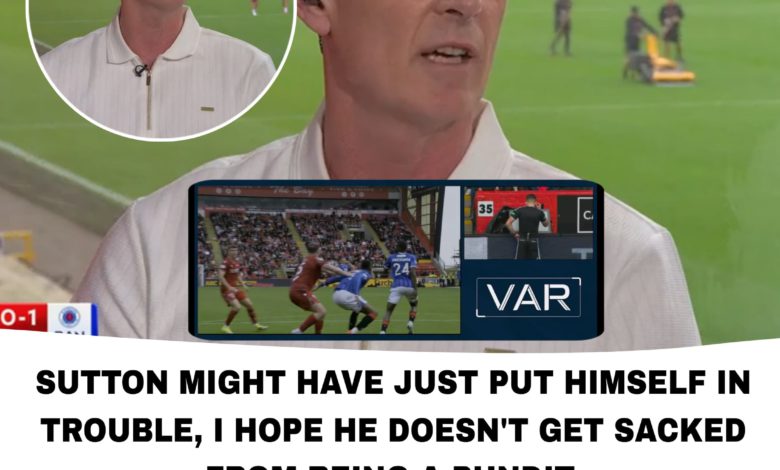
“Sutton might have just put himself in trouble. I hope he doesn’t get sacked from being a pundit.”
Of course, strong criticism of refereeing decisions is nothing new in football punditry.
Pundits regularly question officials, VAR decisions and refereeing performances, particularly when a controversial decision directly affects the result of a match.
But the intensity surrounding this particular incident has made Sutton’s comments far more significant.
Aberdeen supporters believe VAR changed everything
From Aberdeen’s perspective, the frustration is understandable.
The home side believed they had rescued something from a match in which Rangers had taken the lead from the penalty spot.
When the late equaliser went in, Pittodrie erupted.
For a few moments, Aberdeen appeared to have earned a point.
Then came the VAR review.
The referee was asked to reconsider the incident, and after reviewing the footage, the goal was ruled out.
That decision transformed what could have been a memorable Aberdeen comeback into a night of frustration.
The supporters were left asking a simple question: Was there really enough contact to overturn the goal?
That question is unlikely to disappear quickly.
Rangers supporters see it differently
Rangers fans, meanwhile, have argued that the officials made the correct decision.
From their perspective, the Aberdeen player had both hands on the Rangers defender during the build-up, and VAR was right to intervene after identifying an infringement.
They have also pointed out that Rangers themselves had been involved in a major VAR-related decision earlier in the match, with the visitors being awarded a penalty that was converted.
For Rangers supporters, the controversy should therefore not be framed as VAR favouring one team.
They believe the technology simply helped the officials identify incidents that may have been missed during live play.
The bigger question facing Scottish football
Regardless of which side supporters take, the Aberdeen-Rangers controversy has once again raised questions about the way VAR is being used in Scottish football.
The purpose of VAR is to correct clear and obvious errors and ensure that major decisions are made correctly.
But when a goal is initially allowed before being overturned after a lengthy review, the emotional reaction from supporters can be enormous.
The debate becomes even more complicated when the incident involves physical contact inside the penalty area or during the build-up to a goal.
How much contact is enough?
When does normal football become a foul?
And should VAR intervene when the incident is open to interpretation?
Those are the questions dominating the aftermath of the match.
Sutton’s verdict adds fuel to the fire
Sutton’s criticism has ensured that the debate will continue long after Aberdeen and Rangers have left the pitch.
His description of the decision as “daylight robbery” is particularly strong, and it demonstrates just how seriously he views the incident.
For Aberdeen supporters, Sutton has given a voice to what many of them were feeling immediately after the decision.
For Rangers supporters, however, his comments are likely to be viewed as another example of a pundit allowing club loyalties or personal opinions to influence his assessment.
And that is exactly why Sutton’s intervention has become such a talking point.
Scottish football now waits for the next chapter
The Aberdeen-Rangers match may have officially ended with Rangers taking the points, but the VAR controversy is clearly not finished.
The late disallowed equaliser will continue to be analysed from different angles, while Sutton’s comments have added another explosive element to the story.
Whether supporters agree with him or not, one thing is certain: Chris Sutton has made his position very clear.
And with social media still debating his three-word message to the VAR officials, the former striker has once again demonstrated why he remains one of the most outspoken voices in Scottish football punditry.
For Aberdeen, though, the anger is about more than one pundit’s opinion.
They will look back at the match believing that a late equaliser was taken away from them.
For Rangers, it is three points secured.
For VAR, it is another night under intense scrutiny.
And for Sutton, it is another controversial football debate in which he has refused to sit quietly on the fence.