Crystal Palace Boss Thomas Frank Demands PGMOL Investigation Into Coventry City Following Shock 3-2 Defeat

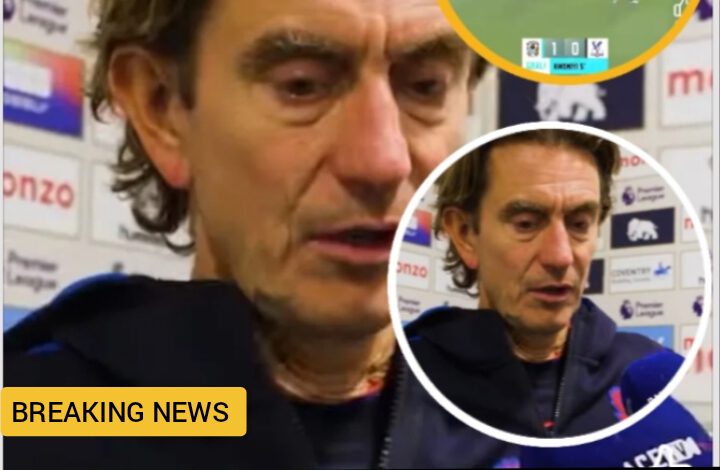
Thomas Frank did not hide his anger. Standing in the mixed zone after Crystal Palace’s 3-2 defeat to Coventry City, the Danish manager delivered a pointed message that has already ignited fierce debate across the Premier League.
Palace had been expected to control the contest. Instead they left the field defeated, and Frank made it clear he believed the manner of the loss went beyond ordinary disappointment. He has now formally called for the PGMOL to investigate Coventry City’s conduct during the match.
“I have asked for a full review of certain incidents,” Frank said. “When you lose a game you accept it if the better team wins. But when you feel the boundaries of fair play are being pushed repeatedly, you have a responsibility to speak. That is what I am doing.”
The 3-2 scoreline itself was dramatic. Coventry came from behind twice and scored a late winner that sent their supporters into raptures. For Palace, the result was a heavy blow. For Frank, the bigger issue was what he described as a pattern of behaviour that he believes requires official scrutiny.
He was specific. “There were a number of moments where players went down under minimal contact and the game was delayed for a long time. There were challenges that were late and unnecessary. And there was a clear attempt to break up the rhythm of the match whenever we started to control it. I am not accusing individuals of cheating. I am saying the cumulative effect needs looking at.”
Frank’s comments immediately raised the temperature. Accusing a newly promoted side of systematically slowing the game and stretching the limits of physicality is a serious charge. Coventry, under Frank Lampard, have built a reputation for organisation and intensity. Frank’s suggestion that this intensity crossed into something less acceptable has not been received quietly.
He continued: “I have no problem with an aggressive team. I have no problem with a team that fights for every ball. What I have a problem with is when the game is constantly interrupted and the referee is put under pressure by prolonged stoppages. That changes the flow. It changes the fatigue levels. And over ninety minutes it can influence the result.”
The Palace manager stopped short of claiming the referee had been deliberately misled, but his call for a PGMOL investigation leaves little room for ambiguity. He wants the governing body for referees to examine the footage and determine whether Coventry’s approach stayed within the laws and the spirit of the game.
“I am not asking for the result to be changed,” Frank clarified. “That is not how it works. I am asking for consistency and for standards to be protected. If this is now considered normal, then we all need to know. If it is not, then something should be said.”
The defeat leaves Palace looking over their shoulders in the table, while Coventry take a huge boost from a result few predicted. That contrast has only sharpened the reaction to Frank’s words. Supporters of the Sky Blues have already accused the Palace boss of sour grapes, arguing that his side simply failed to deal with Coventry’s pressing and directness. Palace fans, meanwhile, have largely backed their manager’s right to raise concerns.
Frank was asked whether he felt the referee had lost control of the match. His answer was careful but telling. “The referee has a difficult job. When one team is constantly going to ground and the other is trying to play at high tempo, it becomes very hard to keep the game flowing. That is why these things need reviewing at a higher level.”
He also addressed the late winner that decided the contest. “We concede goals. That is on us. I take responsibility for the defensive moments. But the overall picture of the match is what concerns me most. It is the pattern, not just the final action.”
The call for a PGMOL investigation elevates the matter beyond a normal post-match complaint. It places Coventry City under official scrutiny and forces the refereeing body to respond, even if only with a statement. That process alone will keep the controversy alive for days.
Inside the Coventry camp the reaction is expected to be robust. Frank Lampard has consistently preached a high-intensity style, and any suggestion that his players deliberately disrupted the game will be strongly rejected. The clash of narratives — one side claiming smart, organised competitiveness, the other claiming something closer to gamesmanship — is exactly the kind of dispute that dominates the football conversation.
Thomas Frank has drawn a line. He believes what he saw against Coventry was not simply a tough afternoon but a test of how far teams can push the boundaries before someone in authority takes notice. By demanding an investigation, he has made sure the debate will not fade quietly.
Whether the PGMOL finds anything worthy of further action remains to be seen. What is already clear is that Frank’s words have landed with force. A shock 3-2 defeat was painful enough for Crystal Palace. The accusation that followed has turned the result into something far more contentious.
The football public will now wait for the next development. Coventry will feel unfairly targeted. Palace will feel their manager was right to speak. And the rest of the league will watch closely to see whether Frank’s complaint produces any official response — or simply becomes another chapter in the endless argument about where competitive edge ends and something less acceptable begins.