“He Refused to Listen!” – Derek McInnes Reveals How his own player Defied His Tactical Instructions During Rangers’ Win

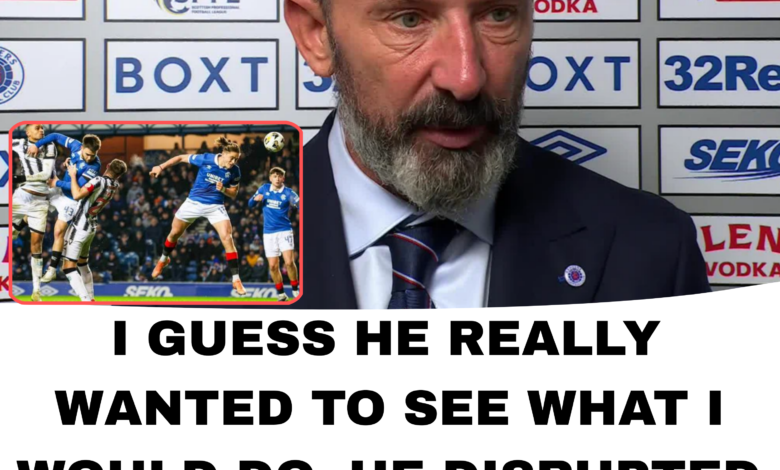
- “If There Is Anything That I Hate, It’s Defying My Tactical Plans” – Derek McInnes Reacts to Nicolas Raskin’s Tactical Rebellion
“He ruined the plan, but we got the goals, so what do you expect me to do now? 😅”
Derek McInnes has jokingly expressed his frustration with Nicolas Raskin after revealing that the Rangers midfielder repeatedly went against his tactical instructions during their encounter with St Mirren.
Rangers secured an important victory in Paisley, but behind the positive result was an interesting tactical disagreement between the manager and one of his most influential midfielders.
While supporters were busy celebrating the goals and another important three points, McInnes appeared to have a slightly different story to tell about what was happening on the pitch.
Speaking after the game, the Rangers boss admitted that he was not entirely pleased with the way one particular player interpreted his instructions, insisting that there was a specific plan that needed to be followed.
“If there is anything that I hate, it’s defying my tactical plans,” McInnes jokingly explained.
The manager, however, was quick to acknowledge that football does not always go according to the instructions prepared before kick-off.
According to McInnes, Nicolas Raskin appeared determined to do things his own way, despite being given clear instructions about his positioning and responsibilities in midfield.
The Belgian midfielder’s willingness to abandon certain aspects of the tactical arrangement reportedly left the manager frustrated on the touchline.
McInnes revealed that he had specifically instructed Raskin to sit deeper and maintain his position rather than constantly moving forward and disrupting the structure he had carefully prepared for the encounter.
However, the midfielder seemingly had other ideas.
“I told him to sit deep, but he didn’t listen. I called him on the touchline and gave him some words, which he never follows. That was his first time of defying my commands,” the manager revealed.
It was an interesting admission, particularly considering that Raskin’s involvement in midfield remained important to Rangers’ overall performance.
The manager appeared to suggest that the midfielder was so convinced about what he wanted to do that even direct instructions from the technical area were not enough to change his approach.
And that was not the end of the story.
McInnes admitted that Raskin’s decision to operate differently from the original tactical arrangement had disrupted the plan he wanted his team to execute.
However, with Rangers finding the back of the net and eventually securing the victory, the manager found himself in an awkward position.
After all, how do you seriously punish a player for ignoring your instructions when the team has just delivered the result you wanted?
“He ruined the plan, but we got the goals, so what do you expect me to do now?” McInnes added with a laugh.
The Rangers manager also appeared to suggest that Raskin might have deliberately wanted to test his patience.
“I guess he really wanted to see what I would do. He disrupted the plan, but we will see…”
That final comment has certainly added another layer of humour to what appears to have been an unusual tactical disagreement between the two.
For Raskin, the incident could be interpreted as an example of a midfielder trusting his instincts and attempting to influence proceedings beyond the boundaries of his assigned role.
For McInnes, however, it raises an entirely different question about discipline, tactical responsibility and the importance of players respecting instructions.
Managers spend hours preparing their teams for specific opponents, identifying weaknesses and assigning responsibilities to individual players. When someone decides to interpret those instructions differently, it can potentially affect the entire team’s structure.
Nevertheless, football is also a game of spontaneity, and sometimes individual decisions produce outcomes that even the manager could not have anticipated.
That appears to be the situation with Raskin.
Interestingly, the Belgian’s willingness to take responsibility and influence the game has often been part of what makes him such an important figure in midfield.
But whether McInnes will tolerate another tactical rebellion remains to be seen.
For now, the Rangers boss can afford to laugh about the situation because the result went his team’s way.
The three points are secured, the goals have been scored, and the supporters have another reason to celebrate.
But one thing is becoming clear: Nicolas Raskin might have won the battle on the pitch, but McInnes will probably have the final word when the team returns to training.
And judging by the manager’s closing remarks, this little disagreement might not be over just yet.