SFA Admits VAR Technology Glitch After Celtic’s Controversial Goal Disallowed Against St Mirren

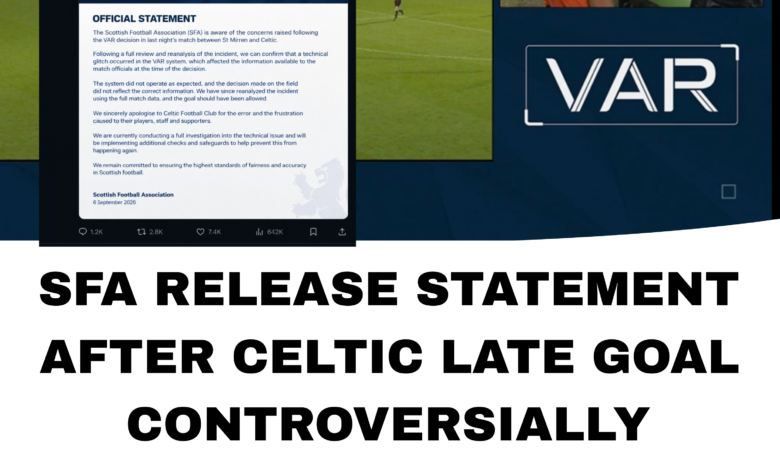
The SFA Has Spoken Out 👀: SFA Releases Statement After Celtic’s Late Goal Was Controversially Disallowed Against St Mirren
The Scottish Football Association has finally addressed the controversy surrounding Celtic’s late goal against St Mirren, admitting that a technical glitch affected the technology used during the decision and issuing an apology to the Parkhead club.
The controversy surrounding Celtic’s dramatic encounter with St Mirren has taken another twist after the Scottish Football Association reportedly acknowledged that a technical glitch in its officiating technology contributed to the controversial decision to disallow what appeared to be a late Celtic goal.
The decision had already sparked widespread debate among Celtic supporters, with many questioning how the goal could possibly have been ruled out after the technology was used to assist the officials.
However, following a further analysis of the incident, the SFA has now admitted that something went wrong with the technology.
According to the statement released this morning, the governing body reviewed the incident and identified a technical malfunction that affected the information available to the match officials at the crucial moment.
The SFA has subsequently apologised to Celtic for what happened.
The admission is likely to intensify the debate surrounding the use of technology in Scottish football, particularly after the incident occurred at one of the most decisive moments of an entertaining match.
A decision that immediately raised eyebrows
Celtic’s late goal initially appeared to have given the Hoops another major moment in their comeback against St Mirren.
The players celebrated, the Celtic bench reacted and supporters believed their side had found the breakthrough they needed.
But the celebrations were short-lived.
The goal was eventually ruled out following a controversial review, leaving Celtic players visibly frustrated and supporters furious.
Questions immediately began circulating over the decision.
Was there an offside?
Was there an infringement?
Had the technology provided the correct information?
Or had something gone seriously wrong behind the scenes?
Those questions became even louder after further analysis of the incident reportedly revealed that the technology had suffered a glitch.
📢 SFA forced to respond
With the controversy refusing to disappear, the SFA was left with little choice but to address the matter.
In its statement, the governing body acknowledged that the technology used during the incident had not functioned as expected.
The SFA reportedly confirmed that the incident was subsequently reanalysed and that the original decision did not accurately reflect what should have happened.
Most importantly for Celtic, the governing body issued an apology to the club.
That apology is unlikely to completely erase the frustration surrounding the incident, particularly because the decision occurred during a match where every goal could potentially have a major impact.
For Celtic supporters, the biggest question now is simple:
How could the technology that was supposed to provide clarity actually contribute to confusion?
Celtic supporters furious
The reaction from Celtic supporters has been understandably strong.
For many fans, the issue is not simply that a goal was disallowed.
It is the fact that technology was introduced into football specifically to reduce controversial decisions.
VAR and other technological systems are supposed to give referees additional information and help them make more accurate decisions.
When the technology itself becomes the source of the controversy, however, it creates an entirely different problem.
Celtic fans have therefore questioned whether the incident should have been handled differently once the system failed to provide reliable information.
Some supporters have argued that the officials should have been alerted immediately that there was a technical problem instead of allowing a questionable decision to stand.
Others have called for greater transparency regarding exactly what happened during the review.
An embarrassing admission?
The SFA’s admission could prove particularly embarrassing because the controversy occurred during such an important moment of the match.
Football supporters accept that referees can make mistakes.
They also understand that VAR decisions will sometimes be subjective.
But when an official decision is influenced by faulty technology, the situation becomes considerably more complicated.
It raises questions about whether the systems are being adequately monitored and whether there are sufficient backup procedures in place when technology fails.
The SFA’s apology is therefore likely to be welcomed by Celtic, but supporters will undoubtedly want more than an apology.
They will want to know exactly what went wrong and what will be done to prevent the same situation from happening again.
Celtic now have every reason to demand answers
The controversy also puts pressure on the Scottish governing body to provide greater clarity.
Celtic can reasonably ask whether the incident would have been handled differently if the technological malfunction had been detected immediately.
The club could also question why the decision was allowed to proceed if the technology was not operating correctly.
For a club competing at the highest level of Scottish football, such incidents are not insignificant.
One incorrect decision can change the momentum of an entire match.
It can affect the players psychologically, influence the opposition and potentially determine the final result.
That is why the SFA’s acknowledgement could become more significant than the original controversy itself.
The bigger VAR debate returns
The incident has once again reopened the wider debate about technology in Scottish football.
VAR was introduced to reduce major errors, but it has frequently found itself at the centre of controversy.
Supporters have complained about lengthy reviews, unclear explanations and decisions that remain difficult to understand even after multiple replays.
The latest Celtic-St Mirren controversy adds another dimension to that discussion:
What happens when the technology itself gets it wrong?
That is a question the SFA will now have to answer.
The governing body has accepted responsibility for the technical issue and apologised to Celtic, but the pressure will now be on officials to demonstrate that lessons have been learned.
Celtic fans will want more than an apology
For Celtic supporters, the apology may provide some acknowledgement that their concerns were legitimate.
But it does not change what happened on the pitch.
The goal was disallowed.
The players had to continue playing.
And the supporters had to watch one of the game’s most controversial moments unfold without knowing that the technology itself was reportedly malfunctioning.
That is why the demand for transparency is likely to continue.
Fans will want the SFA to explain what caused the glitch, how long the problem lasted, whether the match officials were aware of it and what safeguards are being introduced.
One thing is now certain
The controversy that initially appeared to be another ordinary VAR debate has now developed into something much bigger.
The SFA has reportedly acknowledged that a technology glitch played a role in the controversial decision, reanalysed the incident and apologised to Celtic.
For Celtic, it will be a frustrating confirmation that their concerns were justified.
For the SFA, meanwhile, it represents a warning that technological systems are only as reliable as the procedures surrounding them.
And for Scottish football as a whole, the incident provides yet another reminder that VAR is not immune from controversy.
The biggest question now is no longer simply “Why was Celtic’s goal disallowed?”
It is:
“Why was a goal allowed to be disallowed when the technology being used to make the decision was not functioning correctly?”
That is the question Celtic supporters will be asking — and one the SFA will now have to answer.